Sunday, October 13, 2013

Bangkok, Thailand

The first day in a new country is always challenging.  We have chosen a hostel from our guidebook while flying to Bangkok.  We took a train from airport to the city.  Then we were told to take bus number 503 to Banglampoo, the touristy area.  We have waited for an hour for the bus.  It was getting dark.  The traffic started.  Locals were catching taxis.  By the time we decided to take a taxi, it took us about 15 minutes.  All were full.  It costs over the dollar just for sitting.  The meter keeps turning while the car is stopped at the intersection.  I am not sure if the fare is based just on time, or combination of time and distance.  By the way, we later learned that bus number 503 does not go to Banglamboo. The tourist area was busy (more tourists than locals).  We found a cheap hostel for $9 just before the rainfall.  We have moved from one hostel to another a few times in the area.  Some rooms smelled like smoke or had loud neighbors.  The towels, blankets and internet were extra in most rooms.  In one room the internet (which we paid for) was working, but no power supply.  The other issue we had that a fan had only high setting.  We have not been able to get rid of runny noses, since we arrived.  I was not able to get away from the extremely low air conditioned stores,buses and trains, just like in US.  

It seems to be a trend: the cheaper the country, the more we spend.  We allow ourselves to do more things.  I have received more massages in 10 days we spent in Bangkok than in all my life.  The oil massage is my favorite so far.  It costs $10 per hour.  We also went for teeth cleaning and yearly physical health check up in the local hospital.  We got the blood results in 2 hours.  The equipment in the hospital seemed older, but everything was very clean.  The overall experience was very pleasant.  No long waits anywhere.  It was nice to communicate with local people outside of the touristic area, even if it was in the hospital.  No country should be judged by the taxi drivers.  They seemed to be very interested in where we were going.  Some people acted like they knew where we wanted to go.  They would tell us to turn around and go to some tourist attraction. 


A lot of things are cheap in Bangkok, but not tourist attractions.  The entrance to King’s Palace costs twice as much for one person as our hostel room.  In comparison, I would not pay $100 to go to a museum in US, so we did not go to the King’s Palace.  Instead we went to see the Reclining Buda.  We also heard that the prices are different on different days based on the number of tourists.  Instead we went to see the Reclining Buda.  The Buda was inside a small temple, which made it difficult to see the whole Buda at once.  The donation boxes were inside the temple every few steps.  The entrance to the temple was not free.

Also, we noticed that almost all the stalls with food and merchandise were closed on Monday.  The 2 that were open were confiscated by the police.  Apparently, it is illegal to be selling anything on the streets on Mondays in that area.  The vendors have to pay a fine before they can retrieve their belongings.  Two hours later the confiscated stalls were back up with the rest of the stalls on the street.  The police do not bother to come and check twice a day. 

Another adventure was getting a visa to enter Myanmar.  The country opened its borders to tourists only recently.  The information is scarcely available about the visa requirements, entering the country or travelling in the country.  It looks that the rules are continuously changing.  The land borders with Thailand opened only on the 29th of August 2013.  It is still impossible to legally enter Laos from Myanmar by land, which was our original plan.  We may need to get back to Thailand for that. It took us 3 days to get a visa for Myanmar.  We went to the embassy on Monday morning.  There was a line starting outside (around 40 people).  While Dangis was standing in line, I have filled my application.  It was pretty simple: personal information and employment history.  We just had to bring 2 passport photos each and copies of our passports.  By the time Dangis filled his application, it was our turn to receive a number.  After our number was called, we submitted our visa applications and paid $28 per person.  It took us 2 hours.  We left happy and sweaty.  On Wednesday we arrived 15 minutes early.  The line was already formed.  After embassy doors were open a little late, it took us about 10 minutes to pick up our passports with visas. 
So far, we are enjoying Thai food.  The choices are endless.  Just yesterday we tried steamed fish in curry paste, fried calamari and vegetables, coconut juice and ice cream in the world’s biggest weekend market Chatuchak.  The shopping also was an enjoyable experience, although not as exciting as eating.  I got to buy a blouse and a dress for myself.


Friday, October 4, 2013

Taipei, Taiwan

We are flying from Taipei to Bangkok now.  The first time in our lives we barely made our flight.  As usual we arrived at the airport 2 hours before the departure time, but to the wrong airport.  By the time we realized that, we had about 1.5 hours left and 1 hour bus ride to the right airport.  What happened next, sums up perfectly the type of people Taiwanese are.  At the check-in window, the service personnel called the gate to ask them to wait for us.  Then he closed the window to take us to the gate personally.  We skipped all lines.  We passed security check together with pilots and stewardesses.  Then we passed the immigration line with disabled and children.  We made it to the gate in 15 minutes.  As soon as we boarded, the plane left the gate.  We started our trip exactly as scheduled.

We are flying Eva Air (Chinese airlines).  We were served our meals first because we ordered vegetarian, since the meat never tastes good on the flights.  We also were lucky to have one empty seat in between us.  I almost feel like flying first class.  The service is much better that flying any American airlines.
We only had one week in Taipei, Taiwan.  Originally, we planned to start our trip with Thailand.  Since the cheapest flight was through Taiwan, we decided to explore its capital at least.  We did not do much research about the country before starting our trip.  So, we were a little surprised to learn that the prices were comparable to US prices.  We decided to spend our first night in the airport.  Since we were tired after the 13-hour flight, we did not want to pay for a taxi into the city and search for a place to stay in the middle of the night.  We took the first bus the next morning to the center of Taipei.  It took us about 3 hours to find a hostel for $30 (the cheapest we could find).  Finding a place to stay was much more difficult than in South America.  In Taipei, everyone seems to follow the rules.  Nobody wanted to let us in the room until the official check-in time of 2PM or 3PM, without paying for the previous night.
We went to sleep right away.  We slept for 12 hours straight to wake up at 10PM.  The bed was a little short for us, but the room was very clean as the hostel itself.  It took us 4 days to get used to a time change of 13 hours between Chicago and Taipei.
The cleanliness and order of the city reminded me of London.  The clean streets, floors and sheets and neatly arranged lines in the stores, escalators and bathrooms make me happy.  The Taiwanese culture is opposite to South American culture.  Also, we have never felt safer on the streets, even in the middle of the night.  The Taiwanese people are very friendly, helpful and hospitable.

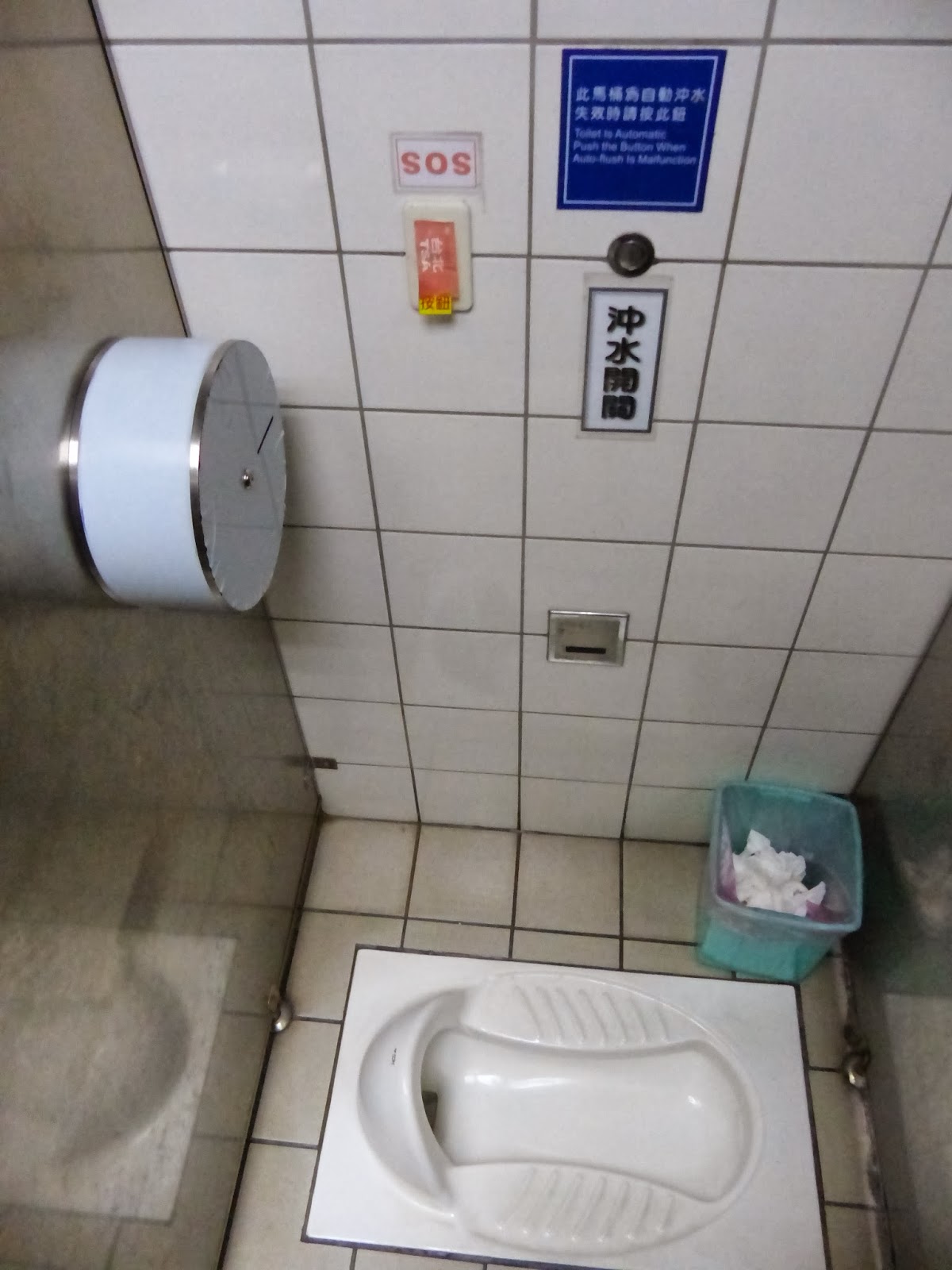
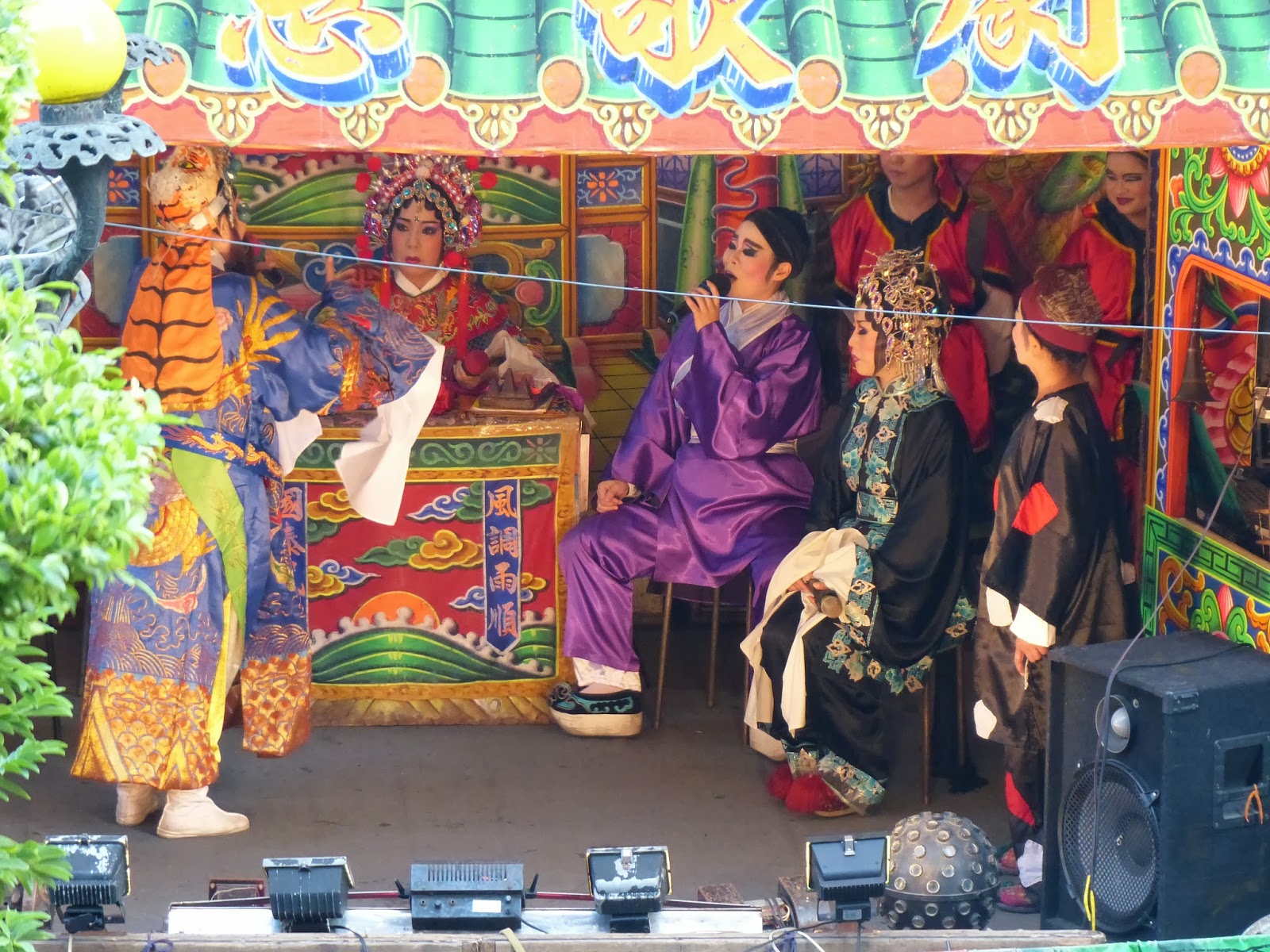
China and Taiwan split up only after the Second World War, but their culture already differs a lot, as we were told.  The Taiwanese culture was not influenced by the Soviet regime and follows the traditions more diligently.  We learned a lot about the history, politics and culture of Taiwan from our new couchsurfing friend Sherry.  After staying in the hostel for 5 nights, we decided to give couchsurfing.com a try.  We found out about the website during our travels in South America.  We send only 5 requests and got 2 positive responses.   Just for comparison, we have sent 50 requests to stay in San Diego and got only 1 positive response.  We were introduced to the everyday life, staying in the residential area.  The night market was not crowded with tourists.  The locals went to see an opera performance in the yard of the temple every night.  There were flowers growing in the balconies, since space is an issue.  The design is always about the function.  Everything is thought through.  Even the bathrooms have the SOS buttons in public spaces.  People are cautious of their health.  The parks are filled with people, practicing tai chi or just stretching.

Tuesday, September 3, 2013

South American Trip Expenses and Experiences

Our trip through South America has ended. We were back in Chicago to enjoy the beautiful summer. We  met with our friends and co-workers. We had couple months "vacation from travelling" in Chicago.  We rested and cleared our heads.   Now we can get our South American trip review.  Here is some statistics from our trip:

The trip started January 23rd.  The duration was 168 days (5.5 months).

Colombia
Ecuador
Peru
Bolivia
Chile
Argentina
46 days
40 days
46 days
28 days
2 days
6 days
$60 / day
$40 / day
$38 / day
$81 / day
$150 / day
$45 / day

We stayed overnight in 43 different cities, towns or villages.  We passed through more than twice than that.
Our travel method was by buses and micro-buses (11,300 km / 7,000 miles). We used planes only twice.
We spent a lot of time in the mountains. The most spectacular views were in  Laguna 69, near Huaraz, Peru, with an altitude of 4,600 m / 15,100 feet.

The highest we've been was Mountain Pastoruri, located near Huaraz also, with an altitude of 5,240 m / 17,192 feet.


In total we spent almost $10,000 for two people per almost half a year, including transportation, plane tickets, accommodations, food, water, alcohol,  internet, tours, medical expenses, entrance fees, supplies and miscellaneous. Here is list of expense categories:

Lodging
Transportation
Food
Internet Phone Mail
Entrance Fees
Supplies
Tours
Water
Medical Expenses
Gift
$2,520
$1,460
$2,075
$160
$480
$85
$560
$75
$100
$440

We did most of the tours and bought all the gifts in Bolivia, since everything was cheaper there.  That's why our expenses average was higher than of Ecuador or Peru.  We loved the jungle tour and the Death Road tour.  The jungle reminded of the big forest, where everything is bigger.  Just being outside for a couple of days surrounded by tall trees and animal noises was an amazing experience.


Riding the bicycles downhill for 63 km / 39 m as the climate and views changed dramatically.  It was exhilarating.

Driving through the salt desert included the best and worst emotions.  The views and our tour group were perfect.  We saw red and green lakes with pink flamingos.  On the other hand, our driver got drunk one night, I got sick one evening, we had to sleep in the negative temperature dressed in all clothes we had.  The experience was definitely memorable.

The most relaxing and enjoyable time we had was in Manta, Ecuador: taking surfing lessons in the mornings, reading books during the day, and swimming in the ocean during sunset.  We made our own breakfast and dinner every day with fresh fruits and vegetables from the local market close to our hostel.  We had a room with the ocean view.  We took naps almost every day.  It was amazing 2.5 weeks.

The best food was definitely in Argentina.  We could not wait for a stake for every dinner while we were there.  The wine was also inexpensive and delicious.  The northern city Salta with its pink cathedral reminded us of Spain a lot.

The graffiti is amazing in all South American countries.  The street artists are great. 


We took 1 week of Spanish in Quito, Ecuador, but it was taking all of our time.  We spent 4 hours in the classroom and about the same time in the hotel room doing homework.  By the end of the trip, we were able to understand a lot of the travel lingo.  It would have been great, if we learned some Spanish before the beginning of the trip.

The most amazing experience was when 2 dogs followed us for 3 days on our trek in Colca canyon.  It was hard-breaking to leave them behind.  Local people live peacefully with street dogs.  The dogs have the freedom to run around, and sometimes get scraps from  locals or tourists.  What a life.

We had the most fun in Cali, Colombia, while we were stuck there because of the coffee farmers strike.  Colombians are very outgoing and friendly.  The most reserved, mean and old-fashioned people we met were Bolivians.  Even though we did make some friends in Bolivia, too.  Our Death Road tour guide Luis became our good friend.

We met a lot of travelers from all over the world. We met people from Brasil, France, Germany, Ukraine, USA, Canada, Australia, England, Poland, Lithuania, South Korea, Israel, Kurdistan (not official republic yet, part of Turkey), Japan, China, Austria, Switzerland, Spain, Finland, Denmark, Nederlands, Belgium, Belarus.
The majority of travelers were from England, France and Germany.  We did meet other people travelling with little kids, some travelling by car or even bicycle.  We got as much good advice as bad.  All people are different, they like different things and have different priorities, and everyone's experiences are unique.  All travelers are a little bit strange: some in a good way, some are just crazy, all have interesting stories to share.

We fly to Los Angeles on September 17th.  After a week in Los Angeles and San Diego, we start our next trip through Southeast Asia with a week in Taiwan.  Then we fly to Thailand in the beginning of October, where we can stay up to 2 months.  After that, our initial itinerary consists of Myanmar, Laos, Cambodia, Malaysia, and Indonesia.  We look forward to meeting more interesting people, learning new things, trying different foods, and evolving.


Thursday, July 4, 2013

Bolivia I

                 Finally we arrived to Bolivia. First stop - Copacabana, it was nice small town, on the lake Titicaca shore, definitely nicer than Puno, Peru. We spent a day in Copacabana and next day moved to Isla del Sol, island in the middle of lake Titicaca. It was a beautiful island with delightful views of snow caped mountain range and stunning dark blue lake water. We even went swimming in the lake (it was cold, but worth it). It crossed my mind that the lake is at 3850m altitude, but it didn´t feel like it, only clouds were lower than usually.
               
                Next day we took the bus to La Paz, Bolivia - big city with around 630 000 inhabitants. We had difficult time finding the hostel - everything was very expensive in comparison to Ecuador and Peru. Finally, I found one decent hostel with reasonable prices for private rooms. It was the Israeli hostel. There were a lot of young people.  One day we passed the guy praying on the stairs. Hostel itself was nice, had beautiful paintings on the walls, even had unlimited hot water in the shower (which was rear). Fun fact: hostel had rules listed in 3 languages: English, Spanish and Hebrew. There were 8 rules in English and Spanish and 11 rules in Hebrew.
                Anyway, La Paz at first glance was huge market place, it didn´t leave us very good impression. There were a lot of old buses, so fumes in the center were impossible, we thought about buying a mask. At first, we thought to go to the jungle in the north, but we couldn´t get airline tickets.  So, we left for Uyuni Salar tour in the south.
                Trip to Uyuni (town where tours to Salar originated) was rough. We took a bus to Oruro and from there - a train to Uyuni. No buses nor trains go in the morning, only at night. Some people like traveling at night, us - no.  Traveling at night you save on accommodation, but hostels in Bolivia are very cheap.  So it is not worth spending our good night sleep in the uncomfortable night buses. Sometimes you are forced to travel at night, as we had to do it to Uyuni. We arrived at 3AM, it was -3 degrees Celsius, and difficult to find a hostel.  We were able to find a shitty one. And the town itself was not nice, very dusty, people were very rude, didn´t give a shit about anything.
                Next day we booked a tour and day after we gathered to the tour agency´s office, where our tour started and continued with "interesting"adventures. As we, all tourists, gathered on time, we couldn´t find our agent. When she arrived (0.5 hour late), we couldn´t find drivers. When they arrived (more 0.5 hour late), agent could´t figure it out who was going with who ( :) it was hysterical!). So we left more than one hour later than planned.
                In our salar tour group we had one couple -Felipe from Brazil and Rossanna from Columbia (both study at university in Brazil). They were wearing little clothes and slippers (it was cold most of the time!). Somebody stole there luggage in Brazil. They were very pleasant companions, singing almost all the time. Other 2 seats in our jeep belonged to 2 french girls, both named Charlotte. They both studied in Canada, they were very nice companions too.We kept changing places with them.
                 The first stop was the train cemetery, it had a lot of train skeletons. The second stop was lunch and the third one was the salt lake. The views were amazing: everything around was white, converging with bright blue sky.
                  Fourth stop was hotel, made from salt, which had a museum inside. That was when we started having issues with the driver - he disappeared for 20 minutes (in the middle of nowhere!). Fifth stop was the fish island, where huge cactuses grow. It takes a year for a cactus to grow 1 cm.. The highest cactus was 10 meters high, so it was 1000 years old. And our driver continued disappearing, this time - 30 minutes.
                  Last stop that day was our hotel, made from salt also, even beds were from salt. Tour guides gave us dinner, Jotvinge couldn´t eat anything, she got sick at the end of the day (maybe because of the rough ride). Second day she was better.
                  Second day we woke up at 7AM, did not get breakfast till 8AM (it was promised at 7am). After long searching, I found the driver - he was drunk. Jotvinge screamed at him, so he got very angry and upset with her (as if it was her fault that he got drunk). We tried to get a phone to call our agency, to change the driver, but there was no reception. I tried asking him to let me drive, but he refused. Our group decided to talk to him again and calmed him down. After all the options, we decided to go with our driver. He promised me not to drink anymore and apologized to Jotvinge. He was driving well while drunk first half of the day, but at the second half he started falling asleep while driving.We almost hit the huge stone, we saw it and started screaming.  After that he started speeding like crazy, we thought we were not going to make it through till the end of the trip. Other than that we saw a lot of beautiful lakes, many elegant pink flamingos, also vicunas, and lamas. We stopped to see an active volcano, we saw "arbol de Piedra" - stones, formed into tree-like shape. There were no trees and very little grass (it was pretty high altitude). It is difficult to imagine what those vicunas and lamas eat there.
                    At the end of the second day, we traveled to see red lake. It looked fabulous at sunset, amazing red color. People say that the lake is red because of some special red bacteria in the lake. Young flamingos eat that bacteria. Depending on how much they eat the bacteria, how pink they become.
                     When we arrived to the second hotel, we received nice dinner and a bottle of wine.  After dinner we joined with other group. We met some Swiss and Spanish people on our way. We had a lot of fun that evening. One guy helped me photograph the stars, I got decent pictures finally. At night was -20 degrees and I would say -5 degrees in our hotel room (was no heat at all!). So that night was terribly cold.
                    We were supposed to get up at 5:30am, but hotel staff woke us up at 4:45AM with breakfast ready. First thing what we did was went to check if the driver was stable. This time we saw him preparing the jeep for our journey (started a fire under the hood -literally). What happened was that day before we had some problems with radiator leaking, so driver was adding water to the radiator (bold move when it is so cold), so at night it froze up. After an hour we were up and running. The first stop was geysers, we felt like in the storm there, but the geysers themselves were warm. The second stop was the thermal baths at shore of the lake. After all the cold, it was heaven to go to the hot water.  The last stop was laguna Verde (green lake). Lake is not green anymore for a few years.  It is beautiful blue. From there we could see two mountains: one facing Argentina, another - Chile.
                       Twenty minutes later ,we reached Chilean border, where the bus was waiting for us....


Thursday, June 13, 2013

Peru

           
Laguna 69, 2013.05.08
  After a nice vacation in Manta, we stopped in Cuenca for a couple of days, then moved to Loja and from there we took a bus straight to Piura, Peru.
              In the bus we noticed that our bag (which was on the top shelf) has moved a couple of times.  Then we spotted the thief who tried to rob us. We took our bags and put them on our knees.  The guy just left the bus during the first stop.
              We finally passed the border and arrived to Peru. At the first glance, the country seemed very different from Colombia and Ecuador.  The landscape changed: desert full with garbage, small and broken houses built from dirt.  It felt as if we entered a different continent, as if we arrived to how we imagined Pakistan or Afghanistan would look.  When we arrived to Piura, we were not able to find a nice and inexpensive hostel.  All of them were really dirty. So, we picked the cheapest one with dirty walls and bed sheets, but it had cable. We were woken up in the middle of the night by somebody talking very loudly.  They did not stop making all kinds of noises until early morning.  We left the first thing in the morning. At least, the food was definitely better than in Ecuador. In Piura I tried now my best Peruvian food - Lomo Saltado (marinated meat and onions with vegetables, rice and potatoes).
               Chiclayo was the second stop after Piura. On the way to Chiclayo we saw sand and trash again, only the center was clean and beautiful. The buses between cities were nice, mostly double deckers with few people selling the goods inside, not like in Ecuador, where it felt like inside the market.
               We found a decent hostel with a nice room with a lot of light on the 4-th floor and started searching Chiclayo and its surroundings. We went to Tucume, where the pyramids are, but it wasn´t very impressive. On the way back we stopped in Chiclayo market. Jotvinge had a camera with her on her shoulder.  Some kid tried to steal it: grabbed the camera and pulled on it very hard, but camera´s strap did not break.  She started shouting, but he just moved couple of steps back looking at her. Then I stepped towards him, he started going away, but not running, even tried to scare me. The thief only ran away when Jotvinge tried to take a picture of him. She did not get a shot.
                We tried some Peruvian sweets: two cookies with condensate milk inside.  It was too sweet, even for me. Coffee in Peru cost more than in Ecuador or Colombia. As far as we noticed, it was not a lot to see in the northern Peru: just sand, dirt and garbage everywhere.
                We decided to go more south. Huanchaco was the next stop, a small town near the Pacific Ocean. There was not possible to swim because of the rocks, but it was a paradise for surfers.  The waves were usually 2-3 meters high. We liked this town, it was nice to relax there for a few days. We found a nice hostel for a good price, surrounded by inexpensive and good restaurants.  We had the best ceviche (raw fish marinated in lemon) there. We met some nice people in Huanchaco, also accidentally we met an American couple, who we first met in Cartagena, Colombia. It was nice to see them again.
                After a relaxing time in Huanchaco, we rolled to Cordillera Blanca (white mountain range) region Ancash capital town Huaraz. It is a nice town with an altitude of 3090 meters and amazing views of mountain range with snow peaks, the highest of which is Huascaran (6789m). As we arrived, we let ourselves get used to the altitude for a couple of days.  Then we started hiking. One day went to laguna Wilkacocha, which was at 3700 m. Another day we went to Llaganuco lake and Laguna 69. It was difficult to reach Laguna 69, but once we finally got there, we thought we were out of space.  The VIEW was spectacular: crystal blue water, surrounded by mountains with their snow peaks merging with the sky.
                 Another hike was to mountain Pastoruri (5240m). It was an easier hike because our tour bus took us to the altitude of 5000 m. On the top we saw 2 lakes with small icebergs and surrounded by huge snow piles. Beautiful.  I would say laguna 69 and mountain Pastoruri was by far the best scenery we have ever seen. Near Huaraz there is a small town of Monterey, where they have thermal baths, which we visited one day too. Jotvinge was sick a little bit because of the weather changes throughout the day, altitude and exhaustion, but we enjoyed mountain range in Ancash.  Also, mangos were very delicious there, as well as their chicken.
                Another stop was Lima. We heard a lot of bad stories about this city (that it is very dangerous, especially in the center), so we prepared for the worst. When we arrived in the dark, we felt safe enough to walk from the bus station to the colonial Lima, looking for a hostel.  We found a beautiful and a great value hostel in the center on the 14th floor with a view of a beautiful huge city (around 8.2 million people).  The next day we visited 5 museums and went to a fountain show (13 beautiful fountains show!!). Lima´s center is very beautiful with lots to do. After sand and mountains, it was very nice to feel a big city´s spirit, enjoy beautiful architecture. By the way, it was a lot of police and army guards there because president Bill Clinton was visiting Peru. It was nice atmosphere there, and we are looking forward to coming back in July for our flight back to Chicago.
                From Lima we decided to go to Nasca, recommended to visit town because of the famous ancient lines and figures, drawn by indigenous a 1000 years ago. The town itself and Nasca lines are definitely overrated, in our minds. The town is small, and people were trying to suck the money out of you. They were charging crazy amounts of money for the tours to see the lines. Instead, we just took a local bus to see them for very cheap.  Nothing amazing. The only thing that was interesting that it haven´t rained in this area for a 1000 years. The people offer to see the Nasca lines from the plane (maybe it would be a nicer view, but definitely expensive). We bought bus ticket to Arequipa, which was expensive too. As far as we noticed Nasca was like a trap - if you get there, you will pay a lot for everything and couldn´t get out of there cheap either. After visiting Nasca, we lost desire to visit Macchu Picchu and Cusco.
                 We arrived to Arequipa around 3AM, but we found accommodation pretty easy. Arequipa welcomed us with cold and rainy days and very cold nights. I got sick, so we needed to stay for a couple of days there, plus we needed to acclimatize to the altitude once more. Next was Colca Canyon (one of the deepest canyons in the world). We took the bus to the heart of Colca Canyon town Cabanaconde. After driving for 2 hours, bus stopped because we almost lost 2 rear tires (good that it did not happen on the mountain road)! We waited for two hours for a replacement bus. We hiked for 3 days in Colca canyon. We went to the thermal baths on the river´s shore in the middle of the canyon. A fun fact was that we had 2 dogs following us around for those 3 days. We ate together, one of them even slept in our room. It was heartbreaking to leave them (one tried to get into our taxi). We had fun time in Colca Canyon! We saw lama, named Pepe, which was very friendly. Overall we saw a lot of lamas, vicunas (similar to gazelles). Last day was the most difficult, we needed to ascend 1 km. But it was rewarding also, we saw beautiful, huge condors from very close. It was amazing.  Going back after a few days, the bus broke down before leaving the bus station- dead battery. Driver asked passengers to leave the bus and push it (it was fun!!).
                After Colca we rolled to Puno, to the lake Titikaka. Spent one day there, it was cold because of the altitude. Lake is more beautiful on Bolivia´s side. So next day we took the bus to Copacabana, Bolivia.


Tuesday, April 9, 2013

Ecuador

It has been a month since we arrived in Ecuador.  The country has a lot of similarities with Colombia, but at the same time it is very different.

First of all, people are shorter here with round faces and high cheekbones- real Indians.  Our first stop in Ecuador was Otavalo- a small town, famous for its artisans market, where its people still dress in the traditional clothing.  Women were long skirts and white blouses with puffy sleeves and beautifully embroidered flowers.  They carry everything on their backs wrapped in a cloth- vegetables, babies or toddlers.  They even work with their babies on the backs, selling vegetables or magazines.  Men wear their long hear under a hat.  We felt as if going back in time to meet people we only saw in movies.  Later, during the Spanish lesson, we learned that over half of Ecuador population in indigenous people, descendants of Inca Indians.

We chose to take one week of Spanish in Quito because everything is cheaper in Ecuador (including the Spanish courses), and we liked the city.  We were considering continuing studying the language for the second week, but Dangis got sick and constant rain and cold changed our mind.  Dangis probably lost 5 pounds that week from losing appetite after getting some parasite, most likely from contaminated food in some restaurant.

The locals seem to be less concerned with cleanliness than Colombians.  We started carrying our own, but I wonder how the cooks wash their hands.  The food in Colombia was more delicious, even though soups in Ecuador are very good, reminds me of Lithuania.  We eat soup here every day for lunch.  Instead of bread, we get plantains with every meal, too.  Also, there are a lot of stray dogs in both countries.  People do not bother them, sometimes even feed them leftovers.

We did not get to see a lot of Quito, since we were studying for the biggest part of the day- 4 hours with the teacher and up to 4 hours of homework.  For most days, there was rain in the morning, hot in the mid-day, and rain or hail in the afternoon.  We had to go through outside to reach the shared bathroom in our hotel, since our room was on the roof with the access to the terrace.

Before starting our classes, we visited Mitad del Mundo (Equator line) and volcano Pichincha park.  At the entrance to the volcano park, the cable car dropped us off at the altitude of 4,100 meters.  Instantly, we started shivering from cold.  We went inside a cafe to dry off the sweat from walking to the park in the heat.  Then, after putting on our jackets, we started our climb to the volcano top, which was at the altitude of almost 4,700 meters and 5 km away.  We had no idea how difficult our climb was going to be.  It took us about 4.5 hours to reach the top.  We were out of breath more and more often the closer we got.  The last hour we probably stopped every 2 minutes for 2 minutes to catch our breath.  We considered and reconsidered to turn back multiple times, even when we were about 100 meters away.  We were unprepared for a climb like this.  We should have, at least, brought more water and gloves.  When we finally reached the top, we could not feel our fingers.  We quickly snapped a few pictures.  The clouds seem to disappear for a moment allowing us to enjoy the magnificent view from the top of the world- the highest we have ever been.  As soon as we turned back, it started to rain heavily.  The rain followed us all the way back for 2.5 hours.  We got back down the volcano soaking wet and freezing.  It was rush hour, soon the sun would set.  It was surprisingly difficult to flag a cab.  In Colombia, the cabs would slow down and beep, passing us to check if we did not need a ride.  But in Quito all the cabs were full.  The driver of the one that picked us up charged us double- 5USD, instead of 2 or 3USD.  He knew that we did not want to stay much longer in the rain, so he ignored our attempt to bargain.  As soon as we were in his cab, though, he started us offering all kinds of overpriced tours, even gave us his card with the description of himself as reliable and honest.


We also noticed that bargaining in Ecuador was different than in Colombia.  In Colombia, there were 2 types of merchants- the ones who lowered the price quickly to be reasonable, and the others who refused to bargain with some explanation, in Ecuador, though, the vendors just kept repeating their original price, as if we did not heat them the first time.

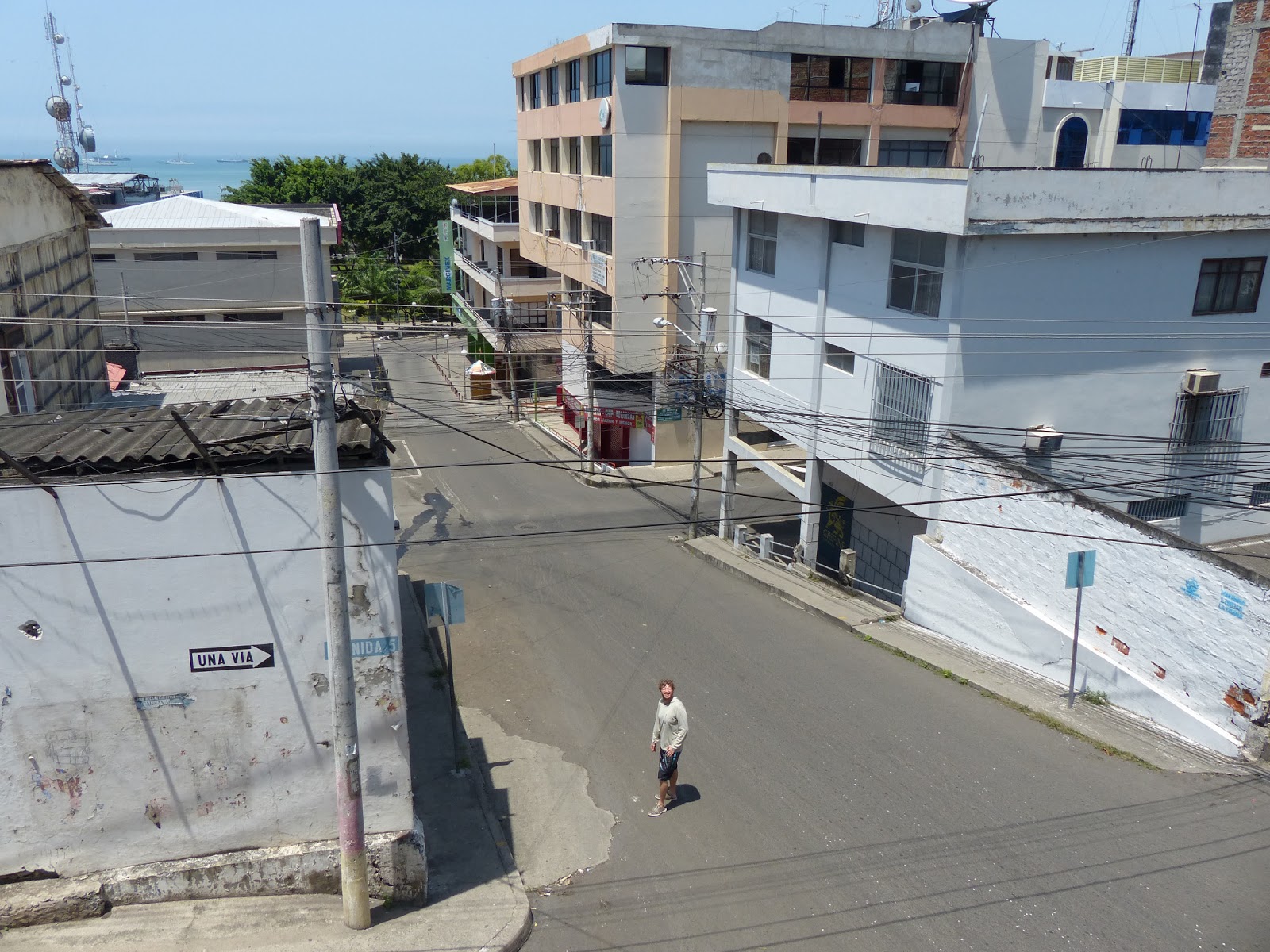
Our next stop Bahia de Caraquez was a nice little town by the coast.  We even considered to stay there for a month or so because of the mild and pleasant climate of the Pacific coast and the relaxed atmosphere of the small town, but big enough to have a market and a store.  We walked the whole town in probably an hour, but we still were looking forward to settling in for a little while- reading books and swimming in the ocean every day.  The little hotel where we stayed was new for a change with a beautiful view of the ocean, access to the roof top, and clean rooms.  It sounded perfect, but we learned that peacefulness was more important.  Somehow we started to feel like we were intruding in the owner's and his girlfriend's lives.  The owner allowed us to use the kitchen of the restaurant down the stairs, but the cook was always there.  We did not feel like paying for our every meal.  We decided to leave Bahia de Caraquez after spending 3 nights in our little hotel, where we were the only guests.

In our bus heading south, we met the first Lithuanian- Vilija travelling with her small daughter.  Apparently, she and her family live in Ecuador for 4 winters now.  Every spring they go back to Lithuania.  Vilija's husband is a famous tattoo artist from my hometown Siauliai, names Giedrius Bardauskas.  He was my neighbor long time ago, even though I do not remember him.  We did not play together because he is a few years older than me.  Giedrius did my sister's tattoo years ago, though.  He also dated my classmate and is friends with my other old friend from Art School.  Small world.

After leaving the bus in San Clemente, very small resort town, we were unable to find reasonably priced accommodations on a big Friday.  Most Ecuadorians get vacation for the week of Easter, and a lot of them go to the coast.  We got onto another bus toward Crucita.  After spending one night there, we really wanted to leave.  The town is so small that there were no stores there.  The restaurants were empty, but very expensive.  The beach was narrow, but very close to the main street.  Our cabin turned out to be very noisy during the night, even though we were the only guests when we arrived.  Talking just outside our door woke us up around 2 am.  After half an hour, I walked outside to see what was happening.  I saw an empty beer bottle on the table. The owner asked me if I needed anything, and I replied 'sleep'.  He said that new people just arrived.  The next morning someone walked in and laid in the hammock outside our door with the music playing from his phone and him singing along.  It appears that people have not heard of headphones.  On the buses we get to listen to someone's music, too.  Nobody seems to mind.  We even saw a blind man getting on the bus, turning on the cassette player, and starting to sing.  After a little concert, he walked with his extended hand, collecting compensation.  The next time we saw another blind man doing exactly the same thing; his voice was not as melodic. 

Nobody waits for the people to get off the bus first before pushing in (Metra culture of Medellin, Colombia, does not exist here).  We did wait once until the people unloaded first, we almost missed it- the doors started closing as we were stepping in.  The girl behind us did not make it.  The bus rides are very cheap in Ecuador.  The city bus rides cost 0.25 USD, and bus rides between cities cost 1 USD per 1 travelled hour.  The gas is much cheaper in Ecuador than in Colombia.  The galon costs from 1.5 USD to 2 USD in Ecuador, in comparison to 5 USD in Colombia.  The roads and sidewalks are equally bad in both countries.  I managed to sprain my ankle because of the uneven pavement in Cali, Colombia.  Dangis banged up his knee into the top of the pole on the sidewalk in Cali, Colombia, too.  In Ecuador, we probably walk on the streets more than on the sidewalks.  Businessmen here have their stands or workshops set up right on the sidewalks.  Also, families walk hand in hand spread across the sidewalks.  Somehow they seemed surprised that we did not vanish by the time they reach us face to face.  We do a lot of wiggling.  I do not recall of having such a hard time walking in Colombia. 

The locals here seem to be extremely proud to be Ecuadorians, more patriotic than Colombians.  When we needed help in Colombia, people would try to help us, sometime even send us the opposite direction.  Colombians would rather give wrong directions than acknowledge that they did not know.  Ecuadorians more often ignore us than not, when we asked them for help. 

We always count our change.  If our change was short, the vendor in Colombia would just quickly and quietly produce the rest of it, but the vendor in Ecuador would argue.  Also, Ecuadorians appear to be more religious than Colombians.  Alcohol is not sold in the stores on Sundays, and most restaurant and little stores are closed.  During a Holy week, Manta, the city we are in right now, was a ghost town.  We found everyone at the beach.  On Fridays, most restaurants serve fish only.  Last Friday we got fish soup and the choice of 3 dishes from fish.  I guess we could here church bells from every hotel room we stayed in, at least in Ecuador. 

Some things in South America remind me of Soviet times in Lithuania.  People cut in lines here all the time.  Sometimes I wish I could speak more Spanish, so I could say something.  A lot stores lock the doors 15 minutes in advance to make sure all people leave before closing time.  The girls wear high heels to the beach, as in Palanga.   Some of the pop music reminds me of older Lithuanian or Russian older pop songs.  There a lot of girls with dancing in all the videos, kind of like in rap videos.  From what I heard, the plastic surgery is the most popular in Colombia.  Also, there are a lot of old LADA cars in Ecuador, way more than in Colombia.  All the cars are taken care for in both counties- always clean and sometimes even pimped.  And everyone drives like crazy in both countries, too.  The crosswalk and stop signs seem to be totally unnecessary, since nobody stops anyway.  There even exists a beeping language.  I believe I started to understand it.  A driver beeps, if he is passing someone to warn them not to change lanes, if he is approaching intersection, if he sees a pedestrian close by, or someone in front of them stops for any reason. 

For now, we settled in Manta, a reasonable size town with 230,000 people.  Our hostel is located on the hill, so we can see the Pacific Ocean from our room balcony.  The only other guests in our hostel are 4 sailors.  They are at work during the day, so we have the hostel all to ourselves.  The building is old with very high ceilings and spacious rooms.  We also have to share our room with ants, but they do not bother us too much.  We do sometimes get bitten by mosquitos and flies, though. 

After travelling for over 2 months now, we learned to not always listen to other people's advice.  We were advised not to visit Manta because it had nothing special to offer.  So far, we enjoyed it the most and plan to stay here for another week.  I have read a couple of books already, started taking surfing lessons for free, and we swim in the ocean during the sun set, while there is always someone playing soccer on the shore.